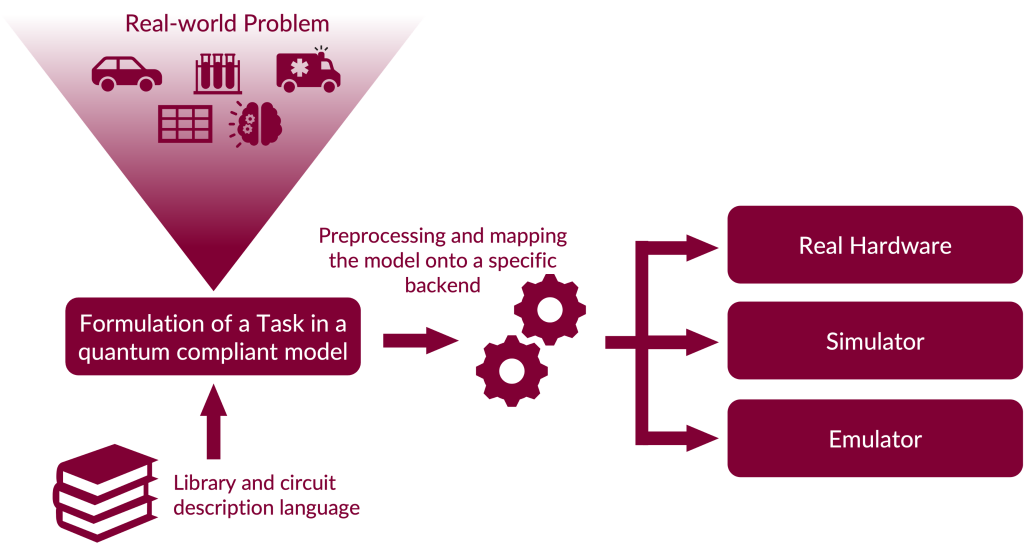
The Quantum activity within QNANO spans the entire quantum computing stack, from algorithmic design to hardware platforms and control electronics, with a strongly integrated hardware–software perspective. Our research begins with the development of quantum circuit libraries for unitary matrix decomposition, arithmetic components, and Quantum Machine Learning (QML) models, enabling modular and reusable building blocks for advanced quantum workflows.
On the algorithmic side, we design both quantum and quantum-inspired algorithms for combinatorial optimization problems, with particular emphasis on QUBO formulations and industrial use cases such as traffic optimization, mobile networks, drone routing, and epidemic control. To support scalable deployment, we develop dedicated toolchains for QUBO reduction and preprocessing, including automated construction from high-level problem descriptions and intelligent selection of the most suitable quantum solver.
We further investigate multi-technology compilation frameworks for quantum circuits, integrating Machine Learning models for backend selection and performance estimation. In this context, we design Graph Neural Network (GNN) predictors that analyze the circuit’s Directed Acyclic Graph (DAG) to enable optimal hardware mapping.
Our work also addresses quantum and hybrid backends through noise modeling, software simulation, and FPGA-based hardware emulation, including Ising machines, Simulated Quantum Annealing, Simulated Bifurcation, and the development of the AMARETTO architecture. Particular attention is devoted to FPGA instrumentation for qubit control and readout (e.g., superconducting qubits), alongside the investigation of physical platforms such as molecular spin qubits, quantum dots, NMR systems, photonic technologies for QKD, and semiconductor-based qubit architectures.
Finally, we design and train Quantum Machine Learning models for real-world applications in finance (fraud detection) and healthcare (disease diagnosis and classification), with systematic analysis of data encoding strategies. Through this vertically integrated approach, QNANO advances scalable, application-oriented quantum systems grounded in both computational theory and experimental implementation.